
6 Signs You’re Probably Underfueling
You're showing up and working hard, but something's still off.
I hear some version of this almost every week at Dirty Water Fitness. Someone walks in and says, "I'm doing everything right, so why am I so wiped out?" They show up consistently and put in the work, but their energy's gone and they can't figure out what's going on.
Maybe this sounds a little too familiar: You never miss a workout, you push through every set, and you show up even when life is busy. Yet lately your progress has stalled, and your body's not responding the way it used to. This is point where people usually wonder if they need to cut something out of their diet. But I’d bet a million dollars that you’re just not eating enough for everything you're asking your body to do.
Chronic underfueling can slide you into something called “low energy availability.” It’s a state where your body doesn't have the leftover energy it needs to keep essential systems healthy after training.
According to the International Olympic Committee's 2023 consensus on Relative Energy Deficiency in Sport (REDs), low energy availability can mess with energy levels, recovery, immune function, bone health, digestion, and performance in both women and men. It's not just one system taking a hit, but a ripple effect across your whole body.
I see this with Dirty Water Fitness members all the time, and it's almost always fixable. Most people jump to thinking they need a tougher program or more discipline. But really, they usually just need more fuel.
As the sports dietitian partnering with Dirty Water Fitness, here are the six most common signs of underfueling I see in active adults. These come straight from the research and from watching what actually happens when someone starts eating enough to support their training.
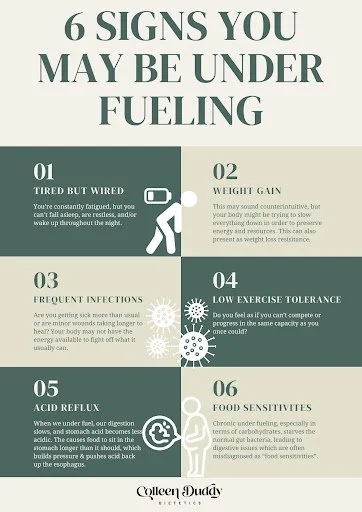
The 6 Signs You May Be Underfueling
1. Tired but Wired
You're dragging all day, but then you finally get into bed and... nothing. You’re restless, can’t fall asleep, and you’re waking up a bunch. Weird, right? You'd think being exhausted means you'd crash out immediately. But underfueling keeps your body in this low-level stress state where your nervous system won't shut off even though you're physically wrecked.
I see this with the early-morning crew at Dirty Water Fitness all the time.
Somebody rolls in for a 6 a.m. lift on little more than coffee because they think fasted training will help them lean out. They grind through the session and then drag through the afternoon. By the time they finally make it into bed, they’re exhausted but wired.
My advice here is usually pretty boring: add some carbs before you train. A banana, some juice, or one of those mini Gatorades we keep in the gym fridge. Something simple that hits fast!
We keep those in the fridge for exactly this reason. It started because one member kept feeling lightheaded during warm-ups, and now it's just a thing we do.

2. Weight Gain (or Weight Loss Resistance)
Your body might be trying to slow everything down to preserve energy and resources.
This sign makes people furious because it feels backwards. People are losing weight at first, but then the weight loss slows down, so they cut calories even more. But your body's not stupid! It’s designed to not let you starve. It senses the food shortage and holds on tighter to whatever you give it.
Eating less just makes your body cling tighter to what it's got.
Some came to me sure they needed stricter meal plans or more cardio because their body composition wasn't budging. Others were flat-out afraid of carbs, keeping calories low and seeing zero change for months. In both cases, things improved when we focused on eating enough, especially around workouts.
Once they bumped up their intake, they started getting stronger and recovering faster. And counterintuitively, their body finally started changing.
People treat performance and body composition like enemies, but hey're not. When your body actually has the resources it needs, changes happen way more easily. I've watched people fight their metabolism for years before realizing they were just underfueled.
3. Frequent Infections
Getting sick more than usual? Cuts taking forever to heal?
Yeah, training stresses the body. That's how “adaptions”, a.k.a. muscle growth, happens. But in order for adaptations to happen, recovery has to happen.
I've had members tell me they thought they just had a "bad immune system" their whole life. Then they started eating enough to support their training, and suddenly they weren't catching every bug they came into contact with. Funny how that works.
So if you feel like you're catching every cold or your bruises take weeks to heal, don't just call it bad luck. I often tell Dirty Water Fitness members to think of their immune system like any other system they're training. Muscles need fuel to recover and get stronger. So does your immune system.
More than once, someone's told me they spent hundreds on supplements trying to stop getting sick, when it turns out they just needed to eat more. I know it sounds too simple, but I've seen it so many times now that I don't even question it.

4. Low Exercise Tolerance
DWF member Katonio was doing everything right. He was showing up consistently, following his program, and eating what he thought was a solid pre-workout meal—eggs, mostly. But his progress just stopped, and he couldn’t figure out why.
That's actually one of the biggest underfueling clues: training feeling harder when it shouldn't.
Research in the British Journal of Sports Medicine found that athletes with low energy availability deal with reduced endurance, worse concentration, and decreased performance. It just makes everything harder.
Before workouts, Katonio would eat eggs—great protein, sure, but not the fast fuel his sessions needed. I suggested adding a quick-digesting carb beforehand, like one of those mini Gatorades or a piece of toast. That little change made a huge difference. His energy came back, and workouts felt more manageable immediately.
Why did this work? Katonio just finally had enough fuel in the tank to match what his training was asking for. Now he's the one telling other members to grab a Gatorade before they lift. He's got the PRs to back it up!
So if you've been grinding for months and nothing's changing, take a hard look at what's on your plate. Katonio did, and it turned everything around.
5. Acid Reflux
Underfueling slows your whole digestive system down. When you're not eating enough, your body's in conservation mode. Digestion slows down and food hangs around, which can cause acid reflux. Most people blame coffee, spicy food, or eating late. Sure, those can cause reflux. But many times, the real culprit is simply not eating enough.
One member spent two years avoiding tomatoes, coffee, anything acidic. Turned out she just needed to eat more total calories. She's back on coffee now and very happy about it.
I've seen plenty of DWF members spend months cutting out foods they thought were the problem. Consistently eating enough, especially enough carbs, cleared up symptoms they'd been living with for years.
Before you start cutting out whole food groups, zoom out. Sometimes your gut isn't reacting to a food, it's just asking for more fuel overall.
6. Food Sensitivities
Another downside of skimping on carbs is that it starves your gut bacteria. And when those bacteria don't get fed, you get bloating, weird digestive stuff, and foods that suddenly feel "off."
Gut health runs on consistency. The bacteria in there need steady nutrients to do their job. If you avoid carbs long enough,your microbiome shifts, which can make things… uncomfortable for you.
I've had people come in sure they'd developed a bunch of food sensitivities. Nope! They just needed to eat more, more consistently. Sometimes feeding your gut—not restricting—is what gets it working again.

The Easy Fix Most People Miss
So you've spotted a few signs that you may be underfeuling, and now you’re wondering how to safely fix the problem. Without talking to you personally, I’d say the easiest place to start is pre-workout fuel.
Eat something with carbs before you train. It doesn't have to be complicated. It can be a banana, applesauce, a handful of crackers, or one of the mini Gatorades we keep in the gym fridge. Something that digests fast and gives you energy without sitting in your stomach.
That's it! That's the whole strategy.
I usually tell folks to start here because it's the easiest thing to try. And both the IOC (International Olympic Committee) and the ISSN (International Society Of Sports Nutrition) back this up. Carbs before training help performance, make the workout suck less, and speed up recovery.
So next time you start worrying about whether you should eat dairy or cut out everything that brings you joy, just remember this: The most important thing is that you need to eat enough so your body can do the work you're asking it to do.
When to Talk to a Sports Dietitian
If a few of these hit close to home, maybe sit down with someone who can look at the full picture. A good sports dietitian will figure out what actually fits your goals, your training, and your actual life, not some meal plan from the internet.
When I work with Dirty Water Fitness members, I'm not here to hand out rigid meal plans or endless lists of foods they can't eat. I help them figure out how to fuel for performance, body comp, recovery, all of it, without making them crazy.
Everyone's schedule and training and goals are different. The changes that actually stick are usually small ones that are tailored to you.
If you want to dig deeper into your own fueling, you can find me here.
I work with DWF members one-on-one, and we figure out what actually works for your schedule, your training, and your life.
Fuel Your Strength with a Team That Gets It
I'm not going to pretend nutrition is simple. It's not. But a lot of the members I work with at DWF are making it way harder than it needs to be.
One reason I enjoy working with Dirty Water Fitness is that the coaches actually pay attention to this stuff. They'll remind you to eat before you train. If your energy's been off, they'll ask about it. They're paying attention to the whole picture, not just what happens under the bar.
And when you pair good nutrition with the training we do, velocity-based work, personalized coaching, the whole approach, you get more out of every session.
They'll coach your technique and push you to challenge yourself when you're ready. And yes, they'll absolutely remind you to eat that pre-workout snack, because they've seen how often that one small habit changes someone's training.
When you fuel better, you get stronger!
Check out our Small Group and 1-on-1 personal training options.
References
Mountjoy M, Ackerman KE, Bailey D, et al. 2023 International Olympic Committee (IOC) Consensus Statement on Relative Energy Deficiency in Sport (REDs). British Journal of Sports Medicine. 2023;57(17):1073–1097.
Ackerman KE, Holtzman B, Cooper KM, et al. Low energy availability surrogates correlate with health and performance consequences of Relative Energy Deficiency in Sport. British Journal of Sports Medicine. 2019;53(10):628–633.