
At some point, you might have found yourself in a stretch wondering, “Is this even doing anything?” Am I holding it long enough, is it deep enough, and does the extra range of motion I feel afterward last past a day or two?
Eventually, you may start wondering whether a few minutes on your own are enough or whether assisted stretching is worth paying for. A trained partner can guide your body into positions you might struggle to set up alone.
The benefits of assisted stretching can include better flexibility and range of motion, and the value of a session also comes from convenience, individual attention, and consistency. At Dirty Water Fitness in Cambridge, MA, I tailor each stretching session to your goals and feedback.
What Is Assisted Stretching?
Assisted stretching is a form of passive stretching. With active stretching, you use your own muscles to move into and hold a position. With partner-assisted stretching, a trained professional helps guide the movement and adjusts your position based on your feedback.
During a session, your stretching partner guides your limbs into position and helps you settle into each stretch. They can adjust the angle or depth as needed, based on your comfort and the movement being worked on. You communicate when the stretch is too much or not enough. Pain is not the goal!
For example, you might lie on a stretching table while your partner guides one leg through a gentle hamstring stretch. You can tell them if the position feels too intense or if you are ready to ease a little further.
What Are the Benefits of Assisted Stretching?
1. Research-Supported Improved Flexibility and Range of Motion
If improving flexibility is one of your goals, assisted stretching can be a useful way to work on your range of motion. A partner can help you reach and hold positions that may be difficult to manage on your own.
Research supports partner-assisted PNF stretching as an effective method for increasing flexibility. Proprioceptive neuromuscular facilitation, or PNF, is one technique used in assisted stretching. It usually involves moving into a stretch, gently contracting the target muscle against resistance for several seconds, then relaxing while your partner guides you slightly further into the position. In a 2012 study, Maddigan and colleagues compared partner-assisted PNF stretching with self-administered PNF and traditional static stretching.
All three methods successfully improved hip range of motion.
Although partner-assisted stretching wasn't significantly more effective than the other methods, the findings confirm that it can be an effective approach to improving flexibility.
2. Reduced Stiffness and Muscle Tension
A guided stretch may help you feel less stiff, especially when you have spent much of the day sitting or repeating the same movements. Cleveland Clinic exercise specialist Ben Kuharik describes assisted stretching as a way to lengthen muscles with external help. He notes that it may help improve range of motion and reduce feelings of stiffness or tension.
3. A More Personalized Stretching Experience
In assisted stretching, I shape that day’s session around your goals and comfort level. You might want to focus on tight hips after long hours at a desk, or work on shoulder mobility to complement your training. I can adjust the stretches as we go. Your feedback helps me decide what to focus on and how to position you.
4. A Convenient Approach to Stretching and Recovery
You hear a lot about “recovery” these days. Should you sit in a sauna or ice bath? Rest, or eat 180 grams of protein per day? Assisted stretching can be one part of your recovery routine. If you exercise regularly, a dedicated stretch session gives you time to work on mobility between workouts and unwind after a busy day.
5. Less Guesswork and More Consistency
This is one of the lesser-known benefits of assisted stretching, but I think it’s pretty critical: it’s super convenient. I talk to a lot of people who want to stretch and even intend to stretch but can’t seem to find the time to do it on their own. When you stretch alone, you have to decide what to work on and fit it into your schedule. With a booked session, the time is set aside and the plan is guided.
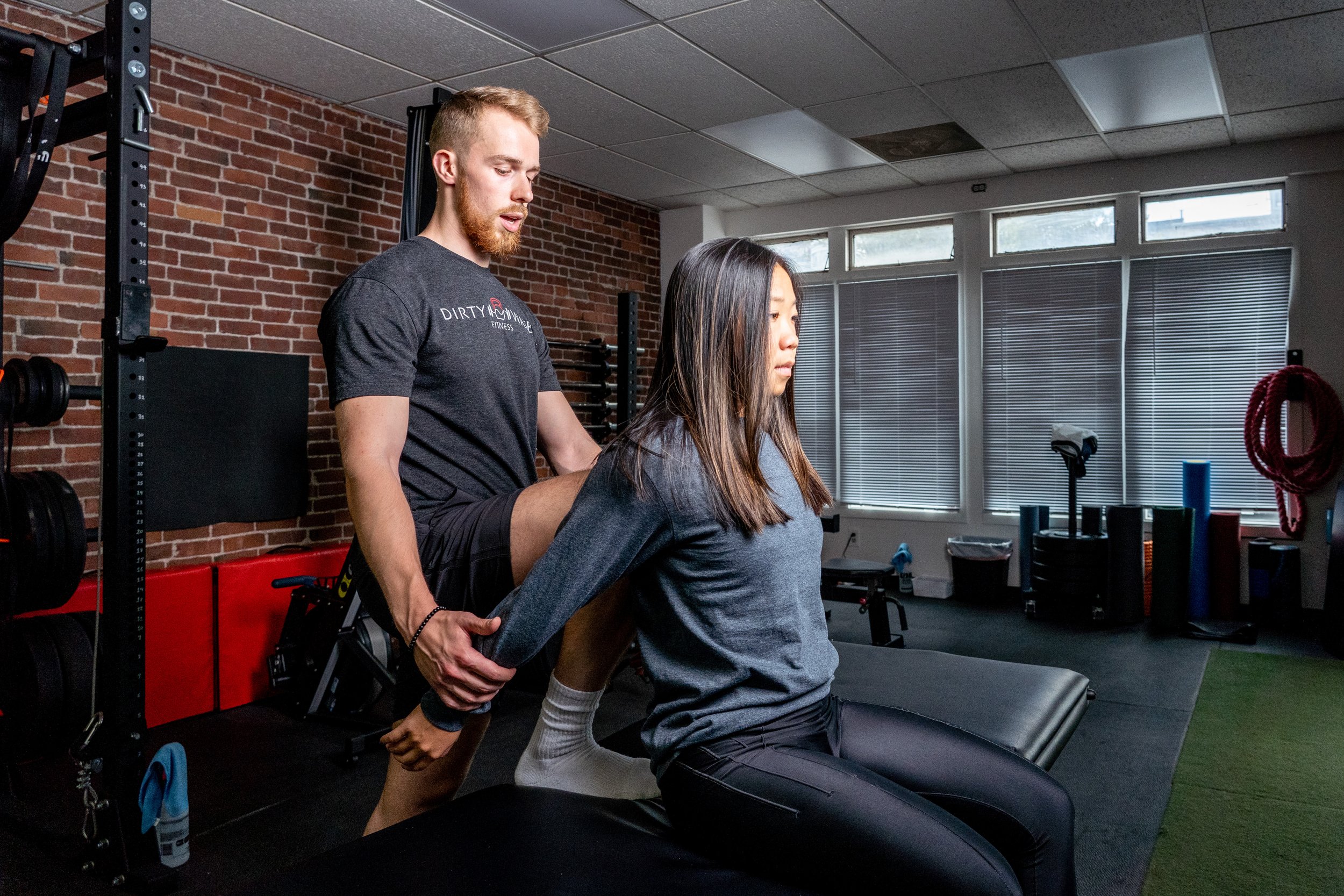
Here’s me guiding a client during an assisted stretching session at Dirty Water Fitness.
Assisted Stretching vs. Stretching on Your Own
I hear a lot of people ask, “Why would I pay for stretching? I can do that on my own.” To which I say, “Yes, but are you doing it on your own?”
Let me put this out there: stretching by yourself works just fine. A consistent home routine can improve flexibility and range of motion, and you can do it without booking appointments or paying for a session. If you already stretch regularly and know what works for you, there’s a good reason to keep doing it.
The research doesn’t say that assisted stretching is better than stretching on your own. But the thing about stretching on your own is that…you actually have to do it. You have to set aside time in your schedule and think about what to stretch and how far to push it and how long to hold it.
With assisted stretching, you can sort of be on autopilot. Someone else has a plan and walks you through it. You also might be more likely to set aside time for stretching when you’ve made an appointment with someone else.
Assistance in stretching changes the experience, not necessarily the physiological outcome.
Assisted Stretching vs. Massage: What's the Difference?
Massage involves hands-on manipulation of soft tissue, such as muscles and surrounding structures. Sessions often use oils or lotions. Clients usually undress to their comfort level and are covered with a sheet or towel. The focus is on working with soft tissue through techniques such as kneading and pressure.
Assisted stretching focuses on moving your joints through their available range of motion. Your partner guides your limbs into position and helps you explore each stretch at a comfortable level. The focus is on movement and flexibility.
Neither service is better than the other. They serve different purposes, and the right choice depends on what you want from the session.
In one of my assisted stretching sessions, you stay fully clothed and lie on a stretching table. There are no oils or lotions. You just relax as I guide you through each stretch and make adjustments based on your feedback.
Does Assisted Stretching Actually Work?
Yes! The research shows that stretching can improve flexibility and range of motion. Assisted stretching offers these benefits with the added advantage of having a trained professional guide your movements and help you get the most out of each session.
Research Shows That Stretching Improves Flexibility
A 2025 systematic review published in Sports Medicine analyzed 189 studies involving 6,654 adults and found that static stretching produced significant improvements in flexibility. Researchers saw moderate improvements after just one stretching session and even greater improvements with consistent stretching over time.
The study also found that people who started with lower levels of flexibility tended to experience greater improvements. That's encouraging news if you've been feeling particularly stiff or haven't stretched in years!
Another systematic review published in the Journal of Sport and Health Science found that regular stretching programs lasting at least two weeks improved joint range of motion, with both static stretching and proprioceptive neuromuscular facilitation (PNF) stretching showing positive results.
So, Is It Worth Paying For?
There's strong scientific evidence that stretching improves flexibility, and assisted stretching is one effective way to get those benefits. While research hasn't shown that professional help gets you better results than stretching on your own, the personalized guidance and convenience can make assisted stretching a worthwhile addition to your fitness.
What to Expect at an Assisted Stretching Session at DWF
Before we start, I'll ask about your goals, activity, and any limitations or areas that need extra consideration. That conversation will help me tailor the session to your needs that day.
You'll remain fully clothed and lie on a comfortable stretching table. There are no oils or lotions involved. I'll guide your body into each stretch and adjust your position based on how it feels.
I'll check in throughout the session. You can tell me when a stretch feels comfortable, when you'd like less intensity, or when you're ready to move a little further. You shouldn’t feel pain, and you should never feel pressured to push beyond a comfortable range. Your feedback is part of the process, so don’t be afraid to speak up!
Try Assisted Stretching in Cambridge, MA
Looking for assisted stretching Cambridge, MA? I offer personalized 1:1 sessions at Dirty Water Fitness with a focus on your goals and comfort. Assisted stretching gives you guidance and convenience, though it does not guarantee better results than stretching on your own. It's an option if you value having a coach guide the session.
If you want to see what assisted stretching is all about, you can book your first stretch at 50% off.
Sources
Cleveland Clinic. (2023, February 27). "Why You Should Try Assisted Stretching." Featuring Ben Kuharik, exercise specialist. https://health.clevelandclinic.org/assisted-stretching
Maddigan, M. E., Peach, A. A., & Behm, D. G. (2012). "A Comparison of Assisted and Unassisted Proprioceptive Neuromuscular Facilitation Techniques and Static Stretching." Journal of Strength and Conditioning Research, 26(5), 1238–1244. https://doi.org/10.1519/JSC.0b013e3182510611
Ingram, L. A., et al. (2025). "Optimising the Dose of Static Stretching to Improve Flexibility: A Systematic Review, Meta-analysis and Multivariate Meta-regression." Sports Medicine, 55(3), 597–617. https://doi.org/10.1007/s40279-024-02143-9
Konrad, A., et al. (2024). "Chronic Effects of Stretching on Range of Motion With Consideration of Potential Moderating Variables: A Systematic Review With Meta-Analysis." Journal of Sport and Health Science, 13(2), 186–194. https://doi.org/10.1016/j.jshs.2023.06.002