Steal This Strength Training Framework
Steal This Strength Training Framework
Since launching Small Group Personal Training in 2023, DWF has helped a lot of people get seriously strong. We’ve seen first pull-ups, first pushups, and first bodyweight squats from people who used to think that strength training wasn’t for them.
Now, we’re giving you the exact framework behind those sessions. You’ll see how we set up the primary lift, fill out the rest of the workout with supersets, and how everything fit together into a full-body session.
If you’ve been wondering how to structure a full body strength workout without turning your training into a random collection of exercises, this is the system to steal. We’ll break down the rep scheme, explain how we choose loads, and give you a sample workout you can steal.
The Framework, in Plain English
Our strength training sessions are built around two simple goals: “Get you strong & powerful with all general movements of the body” and “Give you an effective full-body workout for a minimum of 2 days per week.”
Every session follows that idea. We start with the primary lift, and then move into the first superset, followed by the second superset.
The primary lift gets the most attention because it’s where we want you to move serious weight with good technique. The supersets fill in the rest of the work and make sure the session covers more than one movement pattern.
Next, we’ll break down the primary lift and the 12, 8, 5, 5, 5 setup we use.
Start With Your Primary Lift
The primary lift is the main focus of the session. It’s the first thing you do after your warmup, so nothing else comes before it.
The 12, 8, 5, 5, 5 Setup
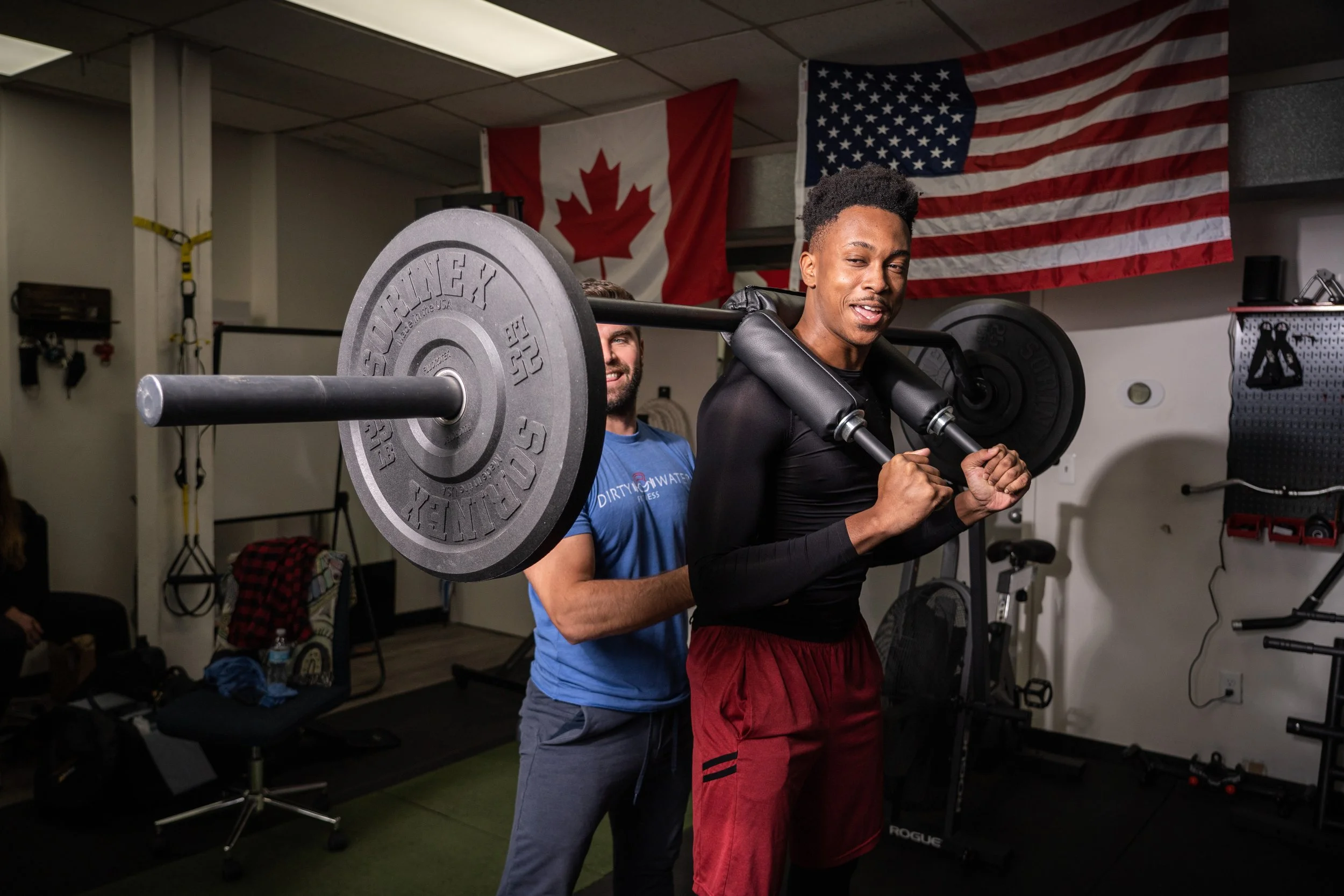
Take the Barbell Back Squat. You’ll start with 12 reps, then 8 reps, then finish with three sets of 5. The 12 and 8 are specific warmup sets. A general warmup gets you moving, but this gets you ready for the specific load and gives you a chance to rehearse the movement before the heavier work.
Keep the 12-rep set controlled. The weight should be moderate — focus on form and range of motion. The 8-rep set brings you closer to your working weight and bridges the gap toward the heavier sets.
Before your first heavy set, take the rest you need. Then come the 3x5 sets. These are the stars of the show. This is where you challenge yourself with weight and lift as heavy as we can with good technique. Look for a weight that’s hard but doable for all three sets. If your technique is solid, you can add some weight. If it falters or you start moving a lot slower, remove some weight.
Five total sets is already a lot of focused work on one lift before you even touch a superset. That’s why we do the primary lift while you’re fresh.
Where Velocity-Based Training Fits
At our Cambridge gym, we also track the velocity of every rep with the Perch system. It uses cameras to measure how fast a target (the weight/bar) is moving. The same type of technology is used with college and professional sports teams.
Tracking the velocity of your reps can help you be sure you’re lifting exactly as heavy or light as you should be. If the bar speed is too slow, the coach can bring the weight down. If it’s moving faster than expected, the load can go up.
Velocity-based training is also supported by peer-reviewed research. For us, the technology gives the coach another piece of information when deciding how hard each set should be.
Use Supersets to Build the Rest of the Workout
Pair the Primary Lift with Its Assistance Work
A superset is two exercises that use unrelated muscle groups, performed as a pair in quick succession.
At DWF, the first superset always includes an assistance exercise to the primary lift, a.k.a. an exercise that is a similar movement pattern. This helps fill in the gaps after the main lift.
Take the sample workout: the Barbell Back Squat is followed by Dumbbell Lunge and Dumbbell Bench Press. The lunge keeps working a lower-body movement pattern related to the squat. The bench press gives another part of the body work while your legs recover.
Pairing unrelated muscle groups lets you keep the session moving without fatiguing the same muscles twice in a row. You get more work done while keeping the primary lift from carrying the entire session.
Then Add the Other Movement Patterns
The second superset keeps filling in the gaps. For example, the Side Plank Reach Through and Dumbbell Rear Delt Flye add different ways to move and stabilize your body. This is part of how we work toward being “strong & powerful in all ways of moving your body.”
The goal across the session is to cover the movement patterns you need to be strong and powerful throughout the body. The primary lift handles the biggest focus. The supersets build around it.
The Full-Body Workout You Can Steal
DWF’s Sample Session
Here’s the full session. Save it, screenshot it, or use it as a reference the next time you’re working through how to structure a full body workout.
Primary: Barbell Back Squat
12, 8, 5, 5, 5 reps
1.A. Dumbbell Lunge
3 x 10 reps per side
1.B. Dumbbell Bench Press
3 x 10 reps
The Dumbbell Lunge is a related lower-body assistance movement for the squat. The Dumbbell Bench Press pairs with it so the same muscle groups aren’t doing all the work.
2.A. Side Plank Reach Through
3 x 15 reps
2.B. Dumbbell Rear Delt Fly
3 x 15 reps
The second superset adds more work around the full-body framework.
That’s the session. The written workout gives you a structure to follow, but it can’t choose every detail for you. Individual coaching still matters when you’re deciding which exercises fit you, how much weight to use, and how to progress over time.
How Often Should You Train?
Two Days a Week Is Plenty
Our SGPT framework is built to give you “an effective full body workout for a minimum of 2 days per week.” That’s the minimum. You can train more.
If you’re looking for a full body workout 2 days a week, this structure gives each session enough work to cover the major movement patterns. You don’t need to split your week into separate body parts when each workout trains the whole body.
Two well-coached sessions can give you a solid base, and some members train at a higher frequency when their schedule and recovery allow it. You don’t need more than that to see progress.
How We Coach It at DWF
The written framework is simple. The coaching is where we individualize the work. Exercise selection, loading, technique, and progression all depend on the person doing the training.
That’s the difference between knowing the structure and having a coach work through it with you. Since launching small group personal training in 2023, we’ve seen members hit first pull-ups, first pushups, first bodyweight squats, and plenty of other strength milestones.
If you’re looking for small group personal training in Cambridge MA, this is the system we use to coach strength in a small group setting.
You can take this framework into a gym and train with it on your own. The structure gives you a clear place to start, and the sample session gives you something concrete to work from. Coaching helps when you need someone to adjust the exercise, load, technique, or progression to fit you.
Start with the primary lift. Build the rest of the session with the supersets. Then keep showing up and getting stronger.