
How to Improve Muscle Power for Longevity
Ever stepped off a curb and caught the edge with your foot? Your foot lands awkwardly, your knee bends, and your other leg shoots out. Maybe you grab the parking meter and laugh it off.
We see smaller versions of this in the gym all the time. A member lands a jump a little heavy, and you can see the difference immediately. The feet hit the floor, the knees wobble, and they look at the coach like, “Okay, that felt weird.”
That kind of reaction is easy to take for granted. We spend most of our training time moving at a pace we choose. Then the box is a little farther away than we thought, and the body has to solve a problem in half a second.
Strength, Power, and Speed Are Not the Same Thing
Strength, power, and speed overlap, but they're different things.
Strength is how much force you can produce.
Power is how quickly you can produce that force.
Speed is how quickly something moves.
You can be very strong and still be relatively slow, just like you can move quickly without producing much force.
A 2025 paper in Mayo Clinic Proceedings looked at whether muscle power predicted mortality better than strength did. Researchers followed 3,889 adults between 46 and 75 for a median of 10.8 years, measuring relative muscle power and relative strength. The group with the lowest relative muscle power had a substantially higher risk of death than the group with the highest power. For men, the hazard ratio was 5.88. The corresponding measure for relative strength wasn't statistically significant.
The paper is Muscle Power Versus Strength as a Predictor of Mortality in Middle-Aged and Older Men and Women. It was published alongside an editorial by Carbone and Alonso called The Need for Speed: Improving Muscle Power for Longevity. The editorial makes the case for giving muscle power more attention alongside the other pieces of fitness we already talk about.
There's an important distinction to make here. This study found an association between muscle power and mortality risk — it didn't prove that training power makes you live longer. Say it with us: “Correlation does not equal causation.”
Still, it raises a useful question. If most of your training happens slowly and under control, are you practicing the physical quality you need when something happens fast?
The Blind Spot in Slow and Controlled Training
Controlled strength training has earned its place in your program. Moving a weight deliberately helps you build muscle and learn where your body should be during a lift. It also makes you stronger, which is no small thing! For a lot of people, especially when they're learning a new movement, slowing things down is exactly the right call.
But strength does not automatically bring speed along with it!
When you deliberately slow down a lift, you're asking your muscles and nervous system to produce force at a slower rate. You still get a training stimulus, meaning your muscles can grow and you can get stronger. Your nervous system just isn't getting much practice producing that force quickly.
There's a training study that compared slow squats with faster squats. The slow group built muscle, but they didn't get better at jumping or sprinting. The faster groups did.
Say you're carrying a laundry basket and a bottle slips off the counter. You don't have time to set your feet, brace, and rehearse the movement. When your body has to react, that’s where power comes into play.
Controlled strength work and power training complement each other. You want the ability to produce force, and you want to be able to call on it quickly. The question is what power training should look like for someone who hasn't jumped in years.
Power Training Is for Everyone, Just Not the Same Version
If you haven't jumped in awhile, the idea of adding jumps to your workout can sound a little ridiculous. Maybe you've been told jumping is hard on your knees. Maybe you picture college athletes doing box jumps with a barbell on their back. Either way, the concern makes sense.
The version we use on the gym floor usually starts much smaller. Before someone leaves the ground, we teach them how to land. A jump-and-stick drill might be a tiny hop into a soft landing, hips back, knees tracking over the toes. No crashing into the floor or knees collapsing inward. It’s not the jumping that wrecks your knees, it’s the landing poorly. That's why we start with landing correctly.
From there, the movement can grow. Step jumps come first, then mini hops and low-amplitude jumps. Later, we can add some repeated jumps and loaded jumps, if they're appropriate.
For someone who doesn't want to jump, or isn't ready for it, power can come from the upper body too. A medicine-ball chest pass or slam lets you practice producing force quickly while your feet stay planted. Lateral shuffles can do this, too.
If you’re recovering from an injury, scaling is important. A coach can watch how you move and find the version that fits where you are right now.
So you’ve decided you want to give your body practice with force and speed. So how much of that practice belongs in your training week?
How to Actually Add Power to Your Routine
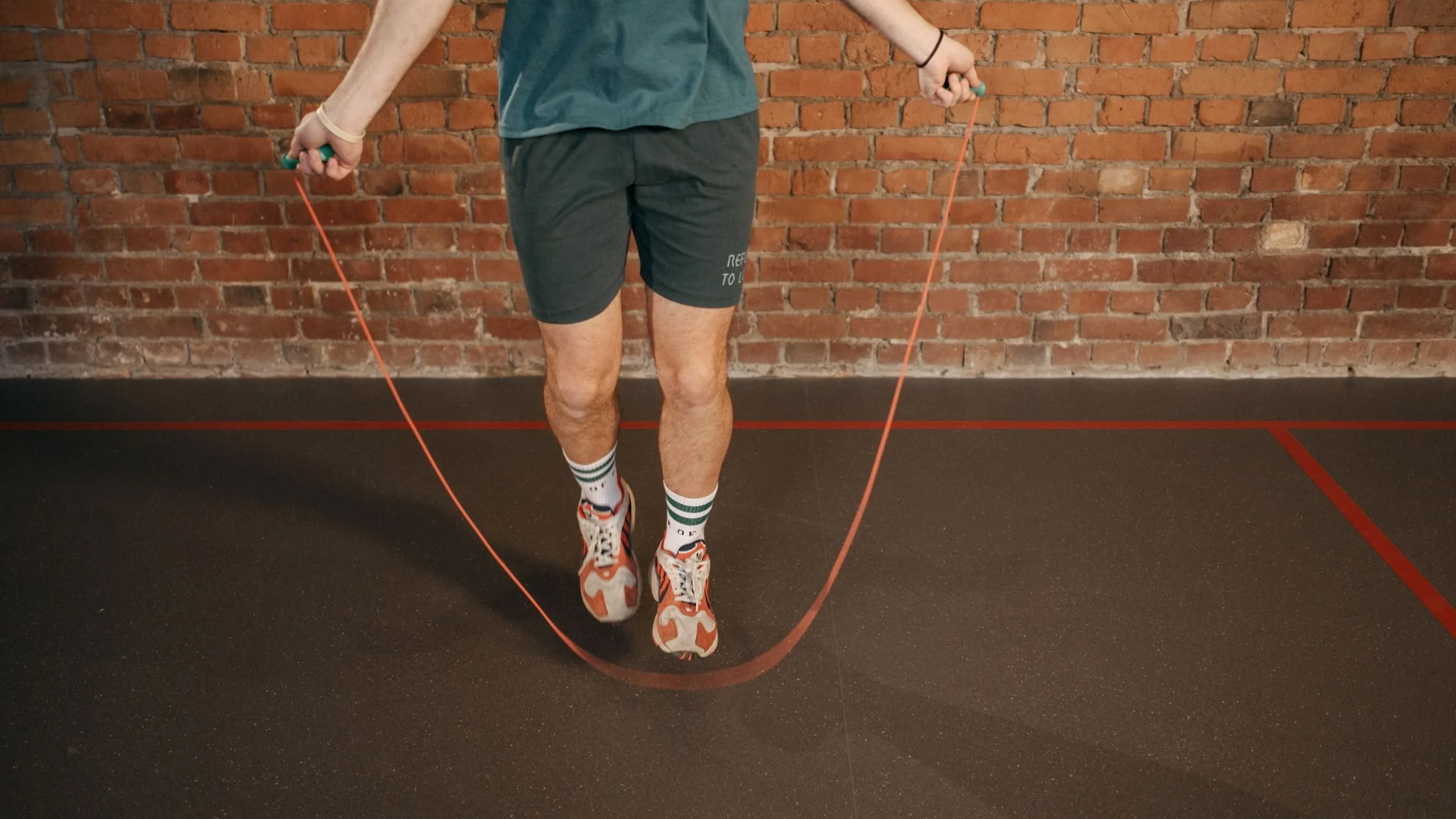
Great news: you don't need a separate power workout. You can add it into your regular gym session. Start with five minutes of jump rope or skipping variations at the beginning of a training session. Try 30 seconds on, 30 seconds off if your calves aren't used to it. The point is to get your feet moving faster and give your body a little practice with quick force before you pick up a heavier weight.
You can also add one or two power exercises after your warm-up and before your strength work. For someone new to jumping, that might mean countermovement jumps. The cue is simple: reach for the ceiling. Once you're comfortable there, a coach might use dumbbell-loaded jumps or trap bar jumps. With dumbbells, the load shouldn't change how you land. With the trap bar, think, “drive the floor away.”
Keep the volume low — two or three sets of three to five reps is plenty. Each rep should look sharp. If the last jump looks noticeably slower or heavier than the first, let’s stop there. Power work isn't supposed to leave you gasping or wreck your legs for tomorrow.
We recommend doing the fast stuff while you're fresh at the beginning of your workout. By the end of a strength session, fatigue has already made you slower, which makes it harder to produce the speed you're trying to train.
You can use both approaches in the same session, too. A few jumps during the warm-up, followed by a few sets of trap bar jumps, gets the job done.
What This Looks Like at DWF
Say a member walks into small group training on four hours of sleep, or work was brutal. Maybe they ran yesterday and their legs still feel heavy. We have a plan for the session, but we also consider the person standing in front of us.
This is where Perch velocity-based-training system really comes in handy. The camera tracks bar speed in meters per second, giving the coach another piece of information to work with. At DWF, speeds below 0.5 m/s tell us the weight is challenging that day. If a warm-up set is moving slower than expected, we can adjust to something more manageable.Instead of saying, “You're doing 135 pounds today,” we might give you a speed zone and let that guide the load. If you’re moving well, we can keep the weight or even add a little more. If your speed drops, we adjust accordingly.
Training speed is important in the long run, because the ability to produce force quickly is one of the first things to decline with age. The earlier you start training it, the more you have to work with later.
Why Power Matters More as You Get Older
You don't have to wait until 70 for this to matter. In fact, please don’t! Research tracking adults across the lifespan found that declines in muscle power were already apparent around age 40. In a study of 1,387 adults ages 18 to 78, the rate of decline in the ability to produce force quickly was about 1.1% per year in men and 1.3% in women. Peak power declined more slowly.
It’s tricky because you can still be and feel strong, but you might not even notice that your power has declined if you’re not training it or putting it to use regularly. You might still be able to lift the dumbbells you've been lifting for years, but then you notice that getting your foot out quickly when you trip feels a little less automatic.
A 2023 systematic review looked at 12 studies involving 478 older adults and found that power training improved performance on tests used to assess functional capacity related to fall risk, including the Timed Up and Go and 30-second sit-to-stand tests. The researchers found greater improvements than with other exercise approaches. The studies measured performance on those tests, so this doesn't mean power training was proven to prevent falls.
It’s ideal to build power before you need it. Your 30s and 40s are a useful time to start practicing the quality that tends to disappear first. A few fast reps belong in your training now, alongside the strength work, the cardio, and everything else you're already doing to stay healthy, really adds up over time.
The Bottom Line
Strength, muscle mass, and cardiovascular fitness have been part of the longevity conversation for years. Power deserves a place alongside them.
That doesn't mean you need another workout on your calendar. At our Cambridge gym, power work is built into the training you're already doing, with the amount and difficulty adjusted to you that day. A few fast movements can easily fit into a normal session.
If you're wondering what power training should look like for you specifically, that's what coaching is for. We run small group and one-on-one sessions in Cambridge, and the program gets adjusted to the person doing it.
Choose your program when you're ready.