Is It Safe to Train When You're Sore? Here's Our Take on Muscle Soreness.
This is probably the question we hear most in Small Group PT. Someone crushes a workout, and then spends the next day waddling around. Inevitably, they ask us: should I skip my next session?
No!
Let me say this right out the gate:
Soreness is only an indicator of new stimulus. There is no better anti-soreness regimen than movement.
We'd way rather you come in, warm up right, and then decide after ten minutes, instead of making the call from your couch. Getting off the toilet hurts? Stairs are torture? Yeah, we know the feeling. But soreness by itself isn't a good reason to bail.
Being sore by itself doesn't automatically mean you're at a higher risk of injury. Muscle soreness, or DOMS, if you want the fancy acronym for Delayed Onset Muscle Soreness, tends to kick in after you introduce something new to your muscles. It could be:
Heavier weight than you're used to
More reps or sets than usual
Lifting at a faster speed
Moving through a bigger range of motion
Usually, it’s your body reacting to something it hasn't seen in a while. It’s annoying, but it’s not a big deal or a safety concern.
What trips people up is that scientists still aren't 100% sure what causes soreness. The two main theories are:
Micro-tears in the muscle fibers (that's the classic DOMS explanation)
Damaged nerve fibers at the ends of the muscles.
We know enough to say this much: soreness isn't injury. And it's definitely not lactic acid. You've probably heard someone say, "I'm sore 'cause the lactic acid is still sitting in my muscles."
Nope.
Lactic acid gets cleared out pretty fast after hard exercise. It's not hanging around for two days making your quads scream every time you touch a stair.
There's a 2025 research review in the Journal of Functional Morphology and Kinesiology that confirms this — the lactic acid theory's been debunked. DOMS comes from microtrauma and inflammation, not leftover lactate. (Di Lorenzo et al., 2025)
Still, we hear this all the time. Someone will say it in a session, somebody else will nod along, and then we have to be the bad guys and break the news again. If we had a dollar for every time someone blamed lactic acid, we could probably open a second gym.
It's adaptation, plain and simple.
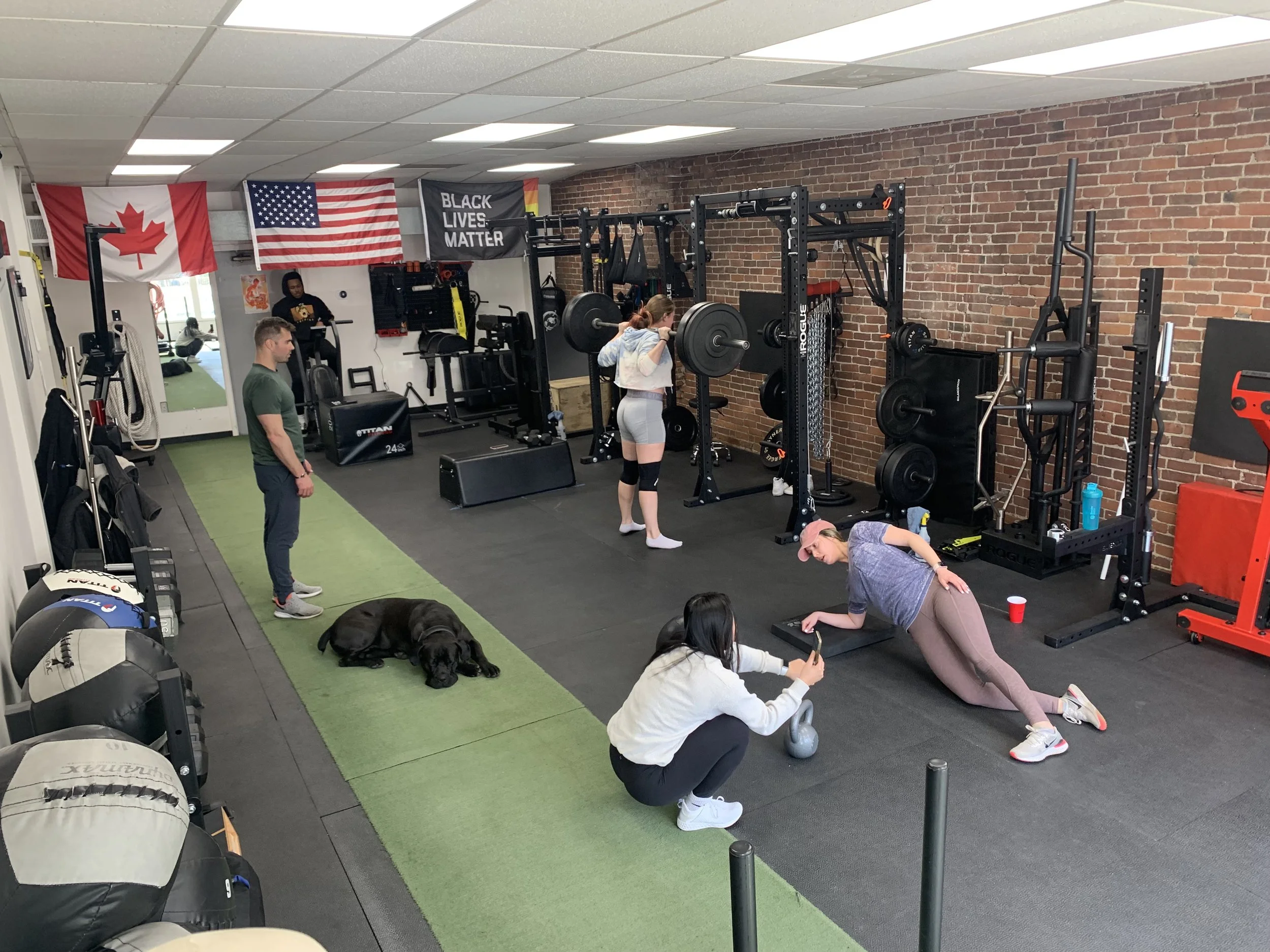
DWF members in the process of getting sore 💪🏼
What To Do When You’re Sore
You can absolutely train when you're really sore. Just warm up first! Get blood moving through those sore spots, and you'd be surprised what kind of session you can still have. We've watched members walk in sure they'd have to go light, and then leave wondering why they almost skipped.
Coach Sara has a warm-up she uses exactly for days like this. It changes a bit depending on what we're doing. For example, the warmup for squatting looks different than for pressing or deadlifting.
Coach Sara’s Anti-Soreness Warmup
Start with 15–20 bodyweight squats to get the blood moving.
Then the World's Greatest Stretch (see below), 5 per side, which loosens up any decreased range of motion in the body from being sore
5 inchworms to wake up the back of the body
10-15 pushups to fire up the upper body
30 pogo hops and 10 medball slams to wake up your nervous system. It's the part of the warm-up where people usually stop feeling creaky and start feeling ready.
Soreness usually comes with stiffness. Your muscles feel tight, and your range of motion isn’t what it normally is. That’s when you know it’s time for a good warmup. The first few reps might feel pretty rough, but almost everybody loosens up after a few minutes of moving.
Sometimes, somebody warms up and just says, "Nah, not today." That happens too, and we're okay with it. We'd much rather make the call after you've moved for ten minutes than when you're still creaky from the drive over.
Leona's Story
Leona is a Judo athlete and Olympic weightlifter. She's in the gym regularly, and she frequently shows up sore from her sport. Sometimes she feels awful and tells us she's not sure how it's going to go.
Instead of sending her home without any movement, we assess only after we've warmed up and started lifting some weight. That’s because she frequently hits PR's while subjectively feeling not her best — and she’s not the only one!
The Bottom Line
So what should you do when you’re sore? Honestly, the best thing is just to move.
It might sound logical to completely rest when everything hurts, but sitting still all day often makes it worse. Walking, light mobility, and easy movement — that's what helps reduce stiffness and actually makes you feel better.
That 2025 review I mentioned earlier backs this up: low-intensity movement can reduce DOMS discomfort. Active recovery beats complete rest. (Di Lorenzo et al., 2025)
That's why we program for consistency over intensity. We want a body that keeps adapting over months.
When is it better to just stay home?
If you've got sharp pain or your range of motion still hasn’t come back even after warming up, then your body is probably trying to tell you something. Tell your coach and we'll help you sort it out. We’re all about “training smarter, not harder” here, and that means knowing when to push and when to just call it a day.
So next time you're sore and not sure whether to show up, just come in and warm up. Move around for ten minutes first, and then decide. Most of the time you'll be glad you came in!
That's how we coach: paying attention to how you're feeling each day, even if that means we have to modify your written program. If that sounds like your kind of coaching, take a look at our small group or one-on-one personal training options. We'll be here — even when you're waddling.
Happy lifting,
Joe at D
References
Di Lorenzo L, Forte AM, Agosti V, et al. Advances in Non-Pharmacological Strategies for DOMS: A Scoping and Critical Review of Recent Evidence. Journal of Functional Morphology and Kinesiology. 2025;10(4):452.
Van Hooren B, Peake JM. Does Exercise-Induced Muscle Damage Play a Role in Skeletal Muscle Hypertrophy? Sports Medicine. 2018;48(7):1575-1595.