
The Benefits of Single Leg Training: A Secret Weapon for Strength & Health
If your training program is all squats, deadlifts, and presses on two legs, you're leaving strength on the table, and you’re probably ignoring a ticking imbalance or two.
That might not matter today, but eventually life asks you to stand on one leg. You’ll catch yourself on an icy sidewalk or sprinting to catch the T. Hiking, climbing stairs, playing basketball, chasing your kids, pushing off a corner during a run… whatever it is, real life and almost every sport demands that one leg absorb force, stabilize, and produce power all on its own.
Because of that, we don't think of split squats, lunges, and single-leg deadlifts as "accessory work." We think of them as valuable strength exercises that deserve dedicated training in their own right.
A lot of people wait until they get hurt before they start training one side of the body at a time. But at our gym in Cambridge, unilateral training is a part of almost every member's program. Year after year, we've watched it build stronger athletes and more resilient bodies.
Fixing Strength Imbalances: Why We’ve Moved Away From "Strict Screenings"
Nobody walks into the gym perfectly symmetrical. Almost everyone favors one side without realizing it. For example, one of your hips moves a little better or one of your legs is a little stronger. Most of the time, you won't notice this until an exercise asks each leg to work on its own.
A lot of gyms love a rigid 30-minute "movement screen" before you even touch a weight. Honestly, we’ve moved away from that lately. We get way more info just by watching you warm up for the first time and seeing how you move through your first few exercises.
For example, a split squat tells us everything we need to know:
Can you comfortably get into enough hip internal rotation?
Does one knee struggle to reach the same depth?
Does one foot stay planted while the other searches for balance?
Does one side simply look smoother?
Are you actually lacking hip internal rotation or knee flexion, or is it just a balance thing?
We don’t need a fancy test to see if one side is struggling; we just use our eyes. If something looks "off," we dig deeper, but we don't obsess over a checklist for the sake of it.
Once we identify the weaker side, that side sets the standard. If your left leg can handle a 50-pound dumbbell with great control but your right leg starts wobbling at 35 pounds, we're using 35 pounds. The goal is to get the weaker side to catch up with the stronger side.
The interesting part, though, is that your stronger side doesn't lose out when you only train one leg…
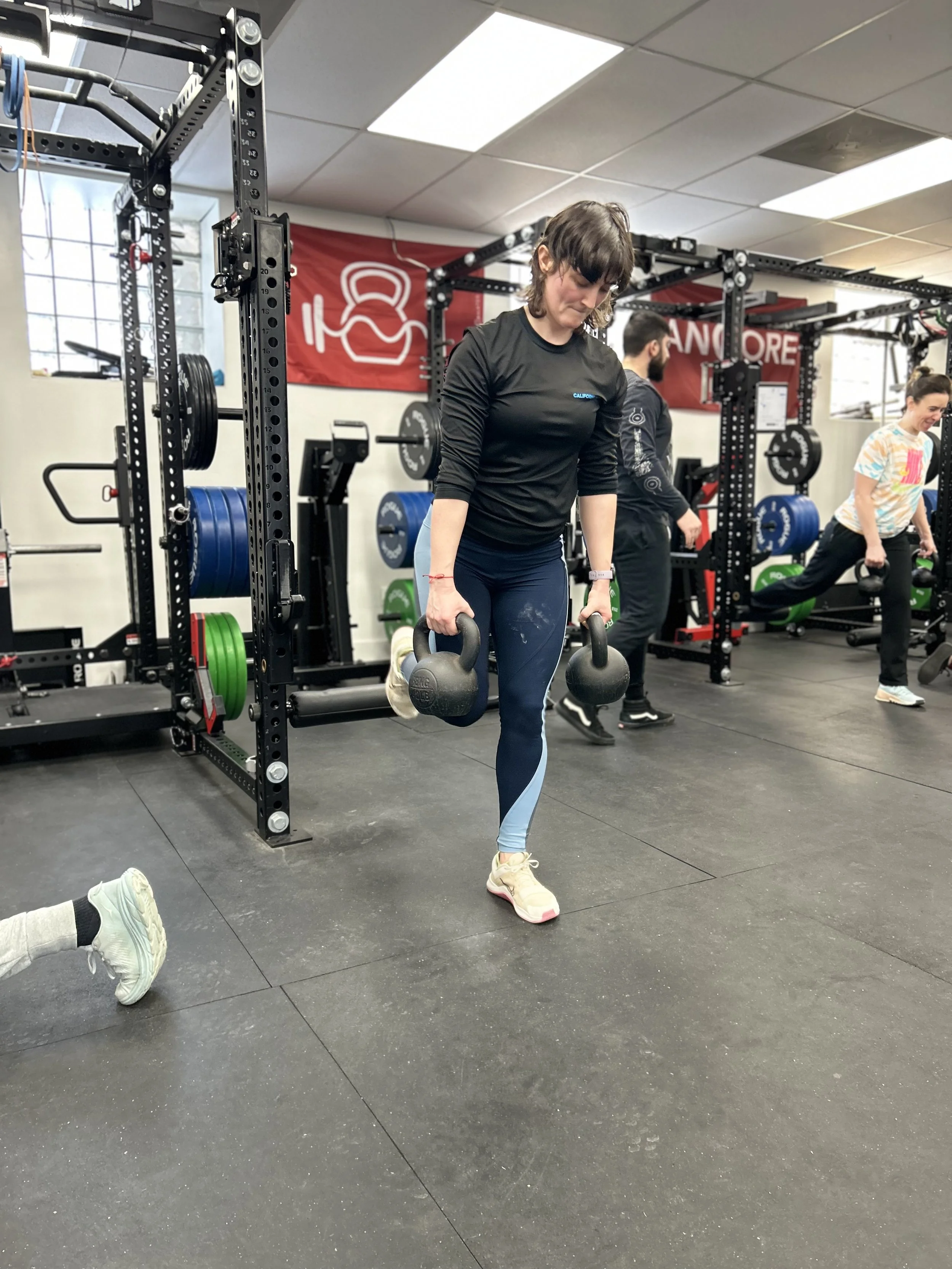
Training One Limb Makes the Other Limb Stronger, Too
A meta-analysis published in the European Journal of Applied Physiology found that training one limb can improve strength in the opposite limb through a phenomenon called cross-education. It's one of the reasons we're comfortable giving extra attention to a weaker leg. Those quality reps are actually helping the non-working side, too.
We also keep side-to-side differences in perspective. A strength difference of around 10–15% is something to be expected. It usually isn't associated with pain or dysfunction, it’s just a normal part of most human bodies — you already know this if you have a “good side” and a “bad side” for certain movements.
Once the gap between sides grows beyond 15%, we just pay closer attention. It isn't a diagnosis or a red flag by itself, but a coaching cue that says, "Let's spend a little more time here."
The goal here isn't perfect symmetry, but we want to make sure one side isn't consistently asking the other side to do all the work.
Improving Your Gym & Sport Performance
This is why single-leg training is one of the best performance tools in our toolbox.
Many people assume the best way to improve a heavy squat is to squat more. Sometimes that's true! But we've also seen plenty of members hit new personal records because they became dramatically stronger on one leg at a time.
One reason for this is something called the bilateral deficit. The name sounds technical, but the idea is simple: many people are capable of producing more total force when each leg works independently than when both legs work together in a bilateral squat. Improving each side individually often helps you express more strength once you put them back together.
Ryan H. showed us exactly what that can look like. Ryan trained with us while preparing for this year's Boston Marathon. Like a lot of runners, he already had the endurance. What we wanted to build was the ability to produce force over and over again on one leg without losing stability or efficiency.
So we spent plenty of time on split squats, single-leg RDLs, and other unilateral work. When race day arrived, Ryan was ready to crush Heartbreak Hill. While runners around him started fading late in the race, he still had the strength to keep climbing and finish strong.
Then something unexpected happened back in the gym. His barbell back squat had gone up. We hadn't even been chasing a bigger squat, but the strength he'd developed through consistent unilateral training carried over into his bilateral lifts.
That's why we call single-leg work a secret weapon.
For runners especially, mileage alone doesn't build resilient legs. Thousands of strides reinforce the same movement pattern over and over, along with the small asymmetries every runner develops. Smart unilateral strength work helps restore balance and improve force production.

Click the image to watch one of our members demonstrate one of our favorite single-leg movements: the skater squat.
Training Around Injuries (Cranky Low Back? No Problem)
There are times when heavy bilateral lifting just isn't the right tool. Like if your low back feels irritated after sitting at a desk all week. Maybe a knee is flaring up or you're coming back from an injury and loading a heavy barbell doesn't feel great yet.
That doesn't mean strength training has to stop! One of the biggest advantages of unilateral training is that it creates a high level of muscular effort with much less total load. Your working leg can be challenged without asking your spine to support the same absolute weight as a heavy bilateral lift.
That's one reason single-leg work stays in our programming all year, not just during rehabilitation. There's research supporting that approach, too. Research published in the Journal of Applied Physiology showed that unilateral strength training helped preserve strength in the opposite limb during periods of immobilization. That's encouraging because it reinforces something we've seen in practice: when someone needs to work around a cranky back, sore knee, or temporary limitation, unilateral exercises can help them keep building and maintaining strength instead of feeling like progress has stopped.
Every situation is different, of course, but having more tools available is always better than having fewer.
Our Approach: Assess, Don't Obsess
A good coach always has their eyes open. We're constantly watching and paying attention to our members.
How does someone set up?
Does anything change between the first and third set?
Does balance improve with a cue? Does mobility open up after a warm-up? Does the weaker side become more confident over a few weeks?
Our process is straightforward:
Check mobility first (hip and knee flexion).
Find the weaker leg.
Let that side determine the load.
That way, we keep things simple and evidence-based.
Make Single-Leg Work Your Secret Weapon
If there's one takeaway, it's this: Single-leg training isn't something you add after the "real workout” or to only do during rehab from an injury. It’s worth mixing into your program all year round.
If you do that, you’ll close meaningful strength gaps between sides before they really start to limit you. Single-leg training builds strength that carries over to your biggest lifts and your favorite sports. And it gives you more options to keep training when life throws you a curveball.
As we often tell members: Life rarely happens on two legs. Being able to absorb and produce force on either side keeps you ready for anything.
So the next time split squats show up in your program, don't rush through them just to get to the barbell! They might be the reason your next PR, your next race, or your next pain-free training block happens in the first place.
Ready to build strength that actually transfers to how you move? Explore our small group or one-on-one personal training.
References
Manca A, Dragone D, Dvir Z, Deriu F. (2017). Cross-education of muscular strength following unilateral resistance training: A meta-analysis. European Journal of Applied Physiology, 117, 2335–2354.
Andrushko JW, Lanovaz JL, Björkman KM, Kontulainen SA, Farthing JP. (2018). Unilateral strength training leads to muscle-specific sparing effects during opposite homologous limb immobilization. Journal of Applied Physiology, 124(4), 866–876.